On captions, evidence, and the work of looking
I visited the Martin Parr retrospective at Photography Seoul Museum of Art (Photo SeMA) three times. On the second visit, a guided tour drew my attention to details I had missed: a woman’s imperfectly manicured nails around a teacup, and rain made conspicuous by flash. Explanation helped me see.
Afterward, however, the explanations and the locations of the singled-out photographs remained more clearly than many of the photographs themselves. That is a recollection of my own visits, not a finding about viewers in general. It leaves a question for my photo-essay books: when does language make an image available to thought, and when does it tell us too quickly what the image has established?
Guidance is already a choice
Roland Barthes’s distinction between anchorage and relay offers a starting point. In anchorage, words guide the identification or interpretation of an image, selecting among possible meanings. In relay, words and images contribute different parts to a larger narrative. The functions can coexist; they are not a simple opposition between restrictive and liberating language.[1]
This distinction complicates the question of how much explanation to provide. Naming an object, proposing a mood, and supplying a narrative do different things even when each takes only a few words. A museum’s factual authority can make its interpretive suggestions seem equally settled. Yet identifying the photographer does not settle what a gesture means.
Barthes began with advertising, where the message is deliberately directed. I would not simply transfer that model to every artwork. A caption in a photo-essay can participate in a fiction whose meaning neither element supplies alone. The task is to identify the relation being proposed before judging it.
Looking longer is not the same as seeing better
Empirical work also resists a simple account of explanation as obstruction. In a 2023 museum study, Castellotti and colleagues tested thirty university students who did not study art, using eight paintings. Participants given detailed labels on a second visit spent longer looking at the paintings themselves than on their first visit with basic labels, excluding reading time. Their ratings of aesthetic appreciation did not significantly increase.[2]
A later screen-based study by the same research group, with sixty participants, did not find a significant increase in viewing time after detailed labels. Self-reported understanding nevertheless improved.[3] These were separate studies, so their difference does not isolate the setting as a cause. Neither tested whether words displaced the later memory of an image.
The distinction matters. Duration, reported understanding, and aesthetic judgment are different outcomes. None alone tells me whether an interpretation deserves assent. My recollection cannot serve as evidence that explanation generally damages looking; these experiments cannot decide whether a particular caption serves a particular work.
What the caption asks a detail to do
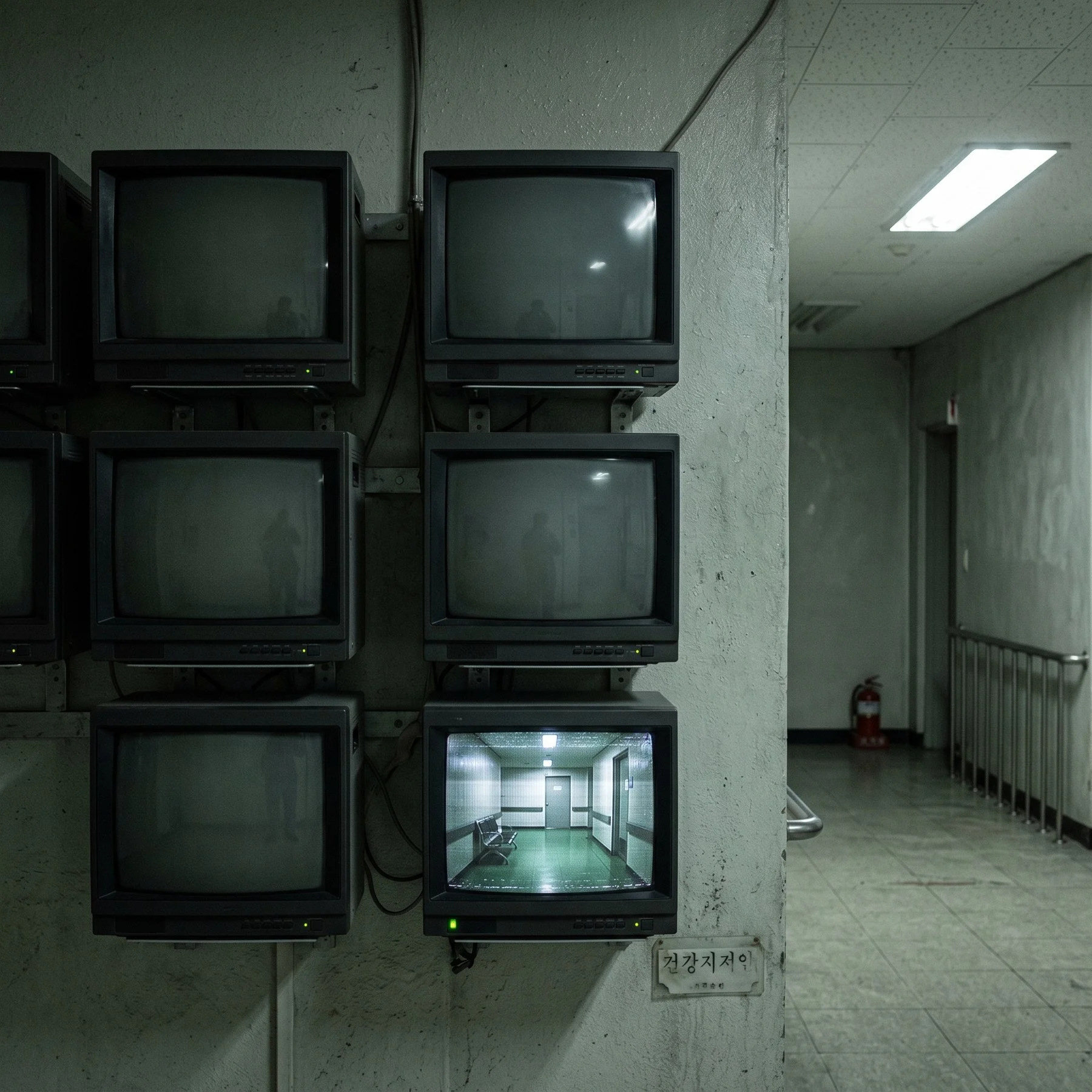
Young Chai, Latent Witness · 07 / 08. AI-generated image. The alternative captions discussed below are editorial proposals, not individual artwork titles.
Consider the image from Latent Witness shown here. Several dim monitors contain faint human-like forms; a bright screen at the lower right displays an empty corridor. The corridor beside the monitors is also empty. These are details available for inspection. Whether the dim forms suggest reflections, recordings, or apparitions is already a further reading.
Keep the production information constant: this is an AI-generated image. Now consider two proposed captions, offered as an editorial comparison rather than an audience experiment: “A bank of monitors” and “Someone was here.” The first names objects. The second gives the faint forms a temporal role, inviting us to take them as signs of a prior presence.
That invitation can be artistically convincing without becoming historical evidence. The visible marks do not establish that anyone occupied a photographed location: the scene was generated. Nor does this fact exhaust the work. The bright corridor and dim figures may sustain a fiction of witnessing, while their uncertain relation prevents that fiction from becoming straightforward documentation.
My question is therefore not whether the second caption adds something absent from the image. It plainly does. I would ask how the particular arrangement sustains, complicates, or resists what the sentence asks us to imagine.
The work may include the words
W. J. T. Mitchell’s account of image–text relations challenges the assumption that a self-sufficient image is always the proper starting point. His discussion attends to the consequences of joining, separating, or subordinating words and images in particular works, including photographic essays.[4] A page should not automatically be judged as a picture with an explanation attached.
This is a serious qualification to my wish to return to the image. The return cannot mean recovering an innocent view from before language entered. In a photo-essay, the text can be part of what there is to encounter. Its contribution may be a voice, a contradiction, or a narrative interval rather than an explanation of visible objects.
But this does not make every pairing equally persuasive. I can ask whether a general sentence would work equally well beside many interchangeable images. If so, I need to examine what this particular image contributes. Conversely, a visual detail that unsettles the sentence may be essential to the work’s tension.
Different claims, different grounds
During forty years in life-science research, deciding how much explanation to give a figure was never easy. That experience makes me attentive to a distinction, not to an equivalence between science and art. A scientific legend supplies conditions needed to examine a claim. It cannot turn an unsupported inference into evidence merely by stating it confidently.
A photo-essay may instead invite an imagined relation. It need not satisfy the same evidential purpose, but a reader should be able to distinguish a documented circumstance from an interpretive proposal or a fictional voice. The image’s production history matters without dictating its entire meaning.
For my own editing, I would replace a general rule about explanation’s length with three questions: What does this sentence claim? What supports that claim—the visible details, verified circumstances, or the relation between words and image? What remains unresolved after we have read it?
The aim is not to make the image win against the words. It is to make their relation worth examining, and to leave enough specificity that a reader can question my interpretation rather than merely inherit it.
References
Barthes, Roland. 1964. “Rhétorique de l’image.” Communications 4: 40–51. Relevant discussion: pp. 44–45. DOI · Read text
Castellotti, Serena, Ottavia D’Agostino, Angelica Mencarini, Martina Fabozzi, Raimondo Varano, Stefano Mastandrea, Irene Baldriga, and Maria Michela Del Viva. 2023. “Psychophysiological and Behavioral Responses to Descriptive Labels in Modern Art Museums.” PLOS ONE 18(5): e0284149. DOI · Read text
Castellotti, Serena, Ottavia D’Agostino, and Maria Michela Del Viva. 2024. “Effectiveness of Labels in Digital Art Experience: Psychophysiological and Behavioral Evidence.” Frontiers in Psychology 15: 1342667. DOI · Read text
Mitchell, W. J. T. 1994. “Beyond Comparison: Picture, Text and Method.” Interfaces 5: 13–38. DOI · Read text
Chai, Young. 2026. “설명이 하는 일 [What Explanation Does].” Brunch, October 18. Blog essay in Korean.
https://brunch.co.kr/@luxlatens/147
This English version extends the Korean essay with a discussion of published scholarship and an analysis of an image from Latent Witness.