Young Chai · Field Notes · October 27, 2026
How making a photobook led me back to research.
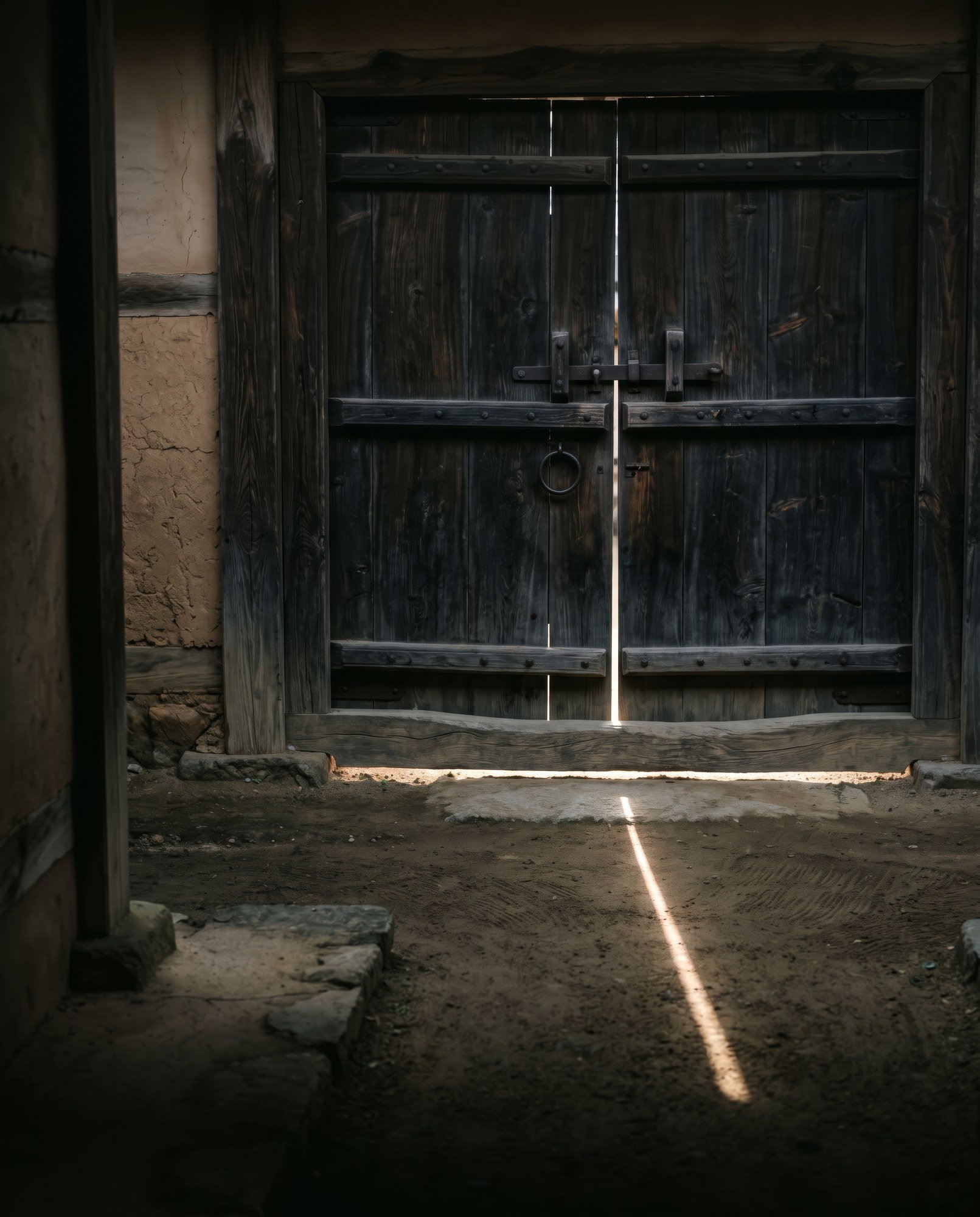
Young Chai, Light Between the Gates. AI-generated and post-processed image; pigment print. From I Tried to Remember.
For once, I have some time to myself this quarter. I am spending that precious time writing papers and books, happily playing on my own, you might say. It has been a while since I felt so much like the person I was before retirement.
What I am doing may seem a little eccentric. I sometimes think so myself. But if I am going to be eccentric, I would like to do it properly.
A ten-year horizon
When I worked in a research laboratory, I always had a goal several years ahead. I planned in five-year blocks, with a horizon of at least fifteen years. I wrote proposals, secured funding, carried out the experiments, and published the results.
When I began photography, I wanted to build my artistic practice in the same way. At first, I could not. I found that deeply disorienting.
The theme I now work with is Latent Expression. I am giving it ten years. I cannot count on the years beyond that as I once could when I was younger.
The photobook I Tried to Remember is one chapter of that larger undertaking.
The house the machine did not know
The book begins with my grandmother's love, received when I was too young to remember it. When I hold my own grandchild, gestures I never learned seem to come of their own accord. My body seems to remember something my conscious memory cannot retrieve.
I wanted to see that love again. Yet when I try to recall her house, only things seen from low down, such as the kitchen floor, remain clear. Her face does not return. Houses with a clay-hearth kitchen and rooms with floor coverings like hers have all but disappeared.
So I asked AI to draw the house. These images were not taken with a camera.
I asked for the same scene twice: once with a description such as “a Korean grandmother's room,” and once using only the name of an object, such as “grandmother's glasses.” Given only the object, the AI put the glasses on a carpet in a Western-style living room. Even when I specified a Korean kitchen, it placed a modern electric rice cooker beside an old hearth.
The machine did not know that house either.
I left the mistakes in the images. My own memory makes mistakes too.
There are no faces in these images. A person appears only in the final one, and that image alone was printed with light in the darkroom, as a silver gelatin print.
I could not bring my grandmother back into view. Still, her love is passing through my body to my grandchild.
The questions that followed
As I made the images, I kept finding things I did not understand. I wanted to understand how AI generates an image, and how an AI-generated image could have a punctum. I wondered how philosophy, aesthetics, and phenomenology could find expression in these images. Making a series, choosing among thousands of images, and arranging a photobook or a photo-essay book raised further questions.
The questions grew out of the work itself:
Where does the body's sense of memory reside?
Why does the light of a place awaken longing?
How is memory synthesized into an image, and why does a new medium borrow the face of photography?
How do the conditions of a prompt change the image?
Can an image that gets things wrong take the place of a photograph? Can it acknowledge its own synthetic nature?
What should I tell a viewer about how an image was made, and why? What happens when the viewer knows it is synthetic?
When I choose a few images from thousands, who is making the selection: the artist or the machine?
I began studying theory to work through these questions, one by one. As I studied, I thought that what I was learning might also be useful to people elsewhere in the world. That was when I began writing papers and submitting them to international journals.
Gradually, things that had seemed scattered began to gather into a single picture. I could see my ten-year theme and direction within it.
From images to manuscripts
The images in I Tried to Remember are now finding their way into papers. Some manuscripts are under review, including revised submissions; others are still being developed. I will only know which of them can grow into a coherent whole after the reviews are complete and I can look at them together.
Alongside the photobook, I have completed the manuscript of Expression, Not Archive, an English-language book in twelve chapters. I am still deciding how it will be published.
For now, this is part of the picture: a photobook, a book manuscript, and a set of questions I am trying to work through. What began with an attempt to picture my grandmother's house has led me back to studying, writing, and making plans.