The last work in I Tried to Remember shows a child’s hand reaching towards a grandmother’s. It belongs to a series made with generative AI from my attempts to describe a childhood I cannot fully recall. For this final work, the generated image was photographed onto film. That film was then used to make a gelatin silver print by hand in the darkroom.
There was a camera exposure. There was film, and there was darkroom printing. Yet the scene of the child and grandmother was already an image before the camera encountered it. Asking whether the finished object is a photograph becomes more useful when I ask a second question: what, exactly, did the camera photograph?
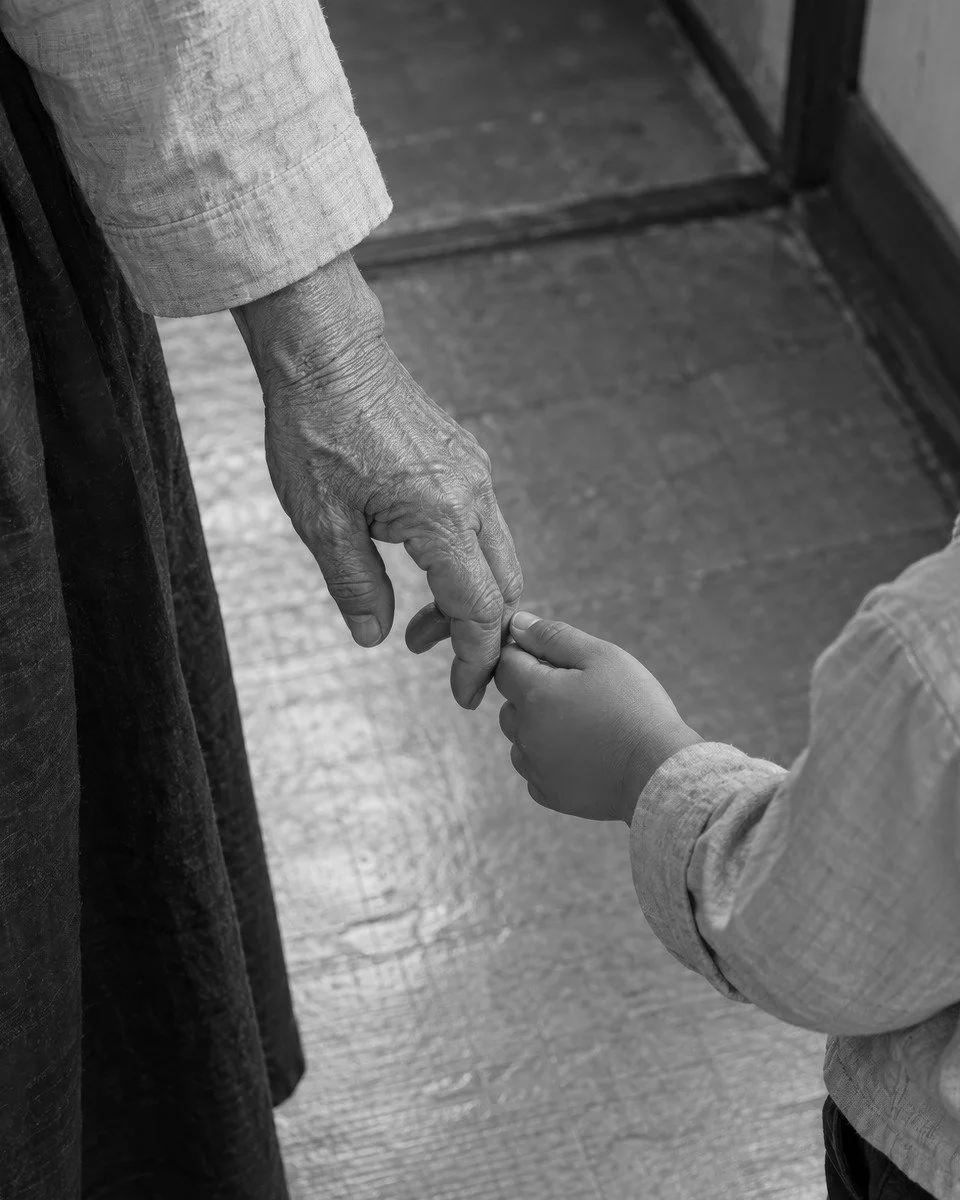
Young Chai, Latent Expression I #20, 2026. AI-generated and post-processed image, rephotographed onto film and hand-printed in the darkroom as a gelatin silver print. Online image reproduction.
The scene and the exposure
A camera can photograph a drawing of a house that was never built. The resulting photograph records an encounter with the drawing. It gives no additional evidence that the house once stood somewhere. Even if the paper’s edges are excluded and the drawing fills the frame, that distinction remains. What the picture depicts and what was before the lens need not be the same thing.
The same distinction matters in my print. At the moment of exposure, the camera received light from an existing image. It did not receive light from my grandmother’s hand in the childhood I am trying to recall. The film records a later encounter with an image made in response to that memory. Rephotography adds a real photographic event to the work’s history; it does not move that event backwards in time.
This leaves the work with different kinds of connection to its subject. Memory supplied a reason to make the image. Generation supplied a visible scene. A camera recorded that scene as it appeared in an already existing image. Darkroom printing gave the film image another material form. These stages can belong to one work without making identical claims about what happened.
What silver changes
Gelatin silver describes a photographic material and process. As the National Gallery of Art explains, paper carrying light-sensitive silver salts in gelatin is exposed through a negative and chemically developed. The visible image consists of silver particles in the gelatin layer. The exposure and the development are distinct parts of making the print. National Gallery of Art: photographic processes.
Those material decisions deserve attention. In making a print, changes in exposure and contrast can alter how a hand emerges from a darker area, or how much separation remains between two nearby tones. The size of the print and the light falling on it also affect how a viewer approaches it. These are possibilities to examine in the object, rather than qualities guaranteed by the words “gelatin silver.”
I cannot use the printing process alone to prove that this version is more moving, more authentic, or better than another version. That would require looking closely at the prints being compared. Nor does the material identify the image’s original source. Getty’s terminology includes digital gelatin silver prints, made by exposing photographic paper with a laser from a digital file and then processing it chemically. That is a different route from the film-camera route used for my work. Getty Art & Architecture Thesaurus.
A camera is not the whole definition
It would also be too simple to make the camera the sole test of whether something belongs to photography. In László Moholy-Nagy’s Fotogramm of 1926, a hand and a paintbrush were among the objects used to make an image on light-sensitive paper without a camera. The Metropolitan Museum of Art identifies the work as a gelatin silver print and classifies it among photographs. The Met: Fotogramm.
The comparison helps locate the question. In the photogram, objects affected the light reaching the paper. In my work, an already generated image supplied the light recorded by a camera. Their histories differ. Recognising both histories gives a more precise account than treating every image on silver paper as evidence of the scene it resembles.
Naming the whole route
A short medium line could read: “AI-generated image, rephotographed onto film and hand-printed in the darkroom as a gelatin silver print.” The phrase gives each stage a place. It distinguishes the digitally generated source image from the camera-made film negative.
This extends the question in my earlier essay, What Does a Caption Ask Us to Believe? Here the caption has to distinguish the scene within the image from the events through which the image became a print. If “photograph” is used, I want the reader to know what was photographed. If “generated” is used, I want the later photographic work to remain visible too.
The hands in this work matter to me because of the relationship I am trying to approach through them. Making a silver print cannot establish that this particular gesture took place in front of a camera in my childhood. Its value has to be considered through the image, the object and its place at the end of the series, with its making described accurately.
Does a generated image become a photograph when printed? I would describe this object as a photographic print of a generated image. The camera recorded that image at a later moment; it did not record the childhood scene depicted within it. The print brings the generated scene into a material history of light, film and paper. What photography adds is a record of making this work, while the childhood it attempts to picture remains beyond the camera’s reach.