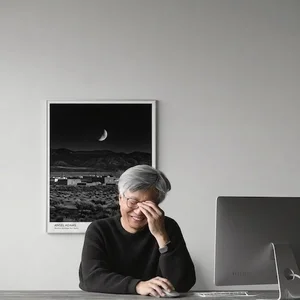
Editorial illustration by nanoglux, generated with Midjourney.
Look at the children on either side of the woman in Dorothea Lange’s Migrant Mother. Both have turned their faces away. You can see how close they stand to her. You can follow the line of a child’s shoulder towards her cheek. Then read the information attached to the photograph in the Library of Congress collection. The woman was thirty-two and had seven children. Go back to the shoulder. Where, exactly, in the picture did you see seven? View the photographs and their captions.
That small difficulty interests me. I can learn something true about a person from a caption and, within seconds, feel as though I had seen it for myself. A reader deserves to know where that knowledge came from. The distinction matters as much to a photographer working with a family album as to an artist making an image from a description.
What the frame can carry
Lange photographed Florence Owens Thompson and her children in Nipomo, California, in March 1936. The familiar portrait belongs to a sequence. The Library of Congress reproduces neighbouring frames with captions of their own. One gives information about the failure of the pea crop. Another records the age of the mother. Laid alongside one another, the frames let us compare distance, gesture and the edges of the shelter. Looking at more frames will never tell us the woman’s age. For that we depend on a record, with all the opportunities for checking and correction that a record entails. Library of Congress, 2025.
There is a further wrinkle. Even a photographer’s later account of making the pictures needs checking. Sarah Meister traced seven exposures through surviving photographs and records, although Lange herself recalled fewer. Meister’s reconstruction matters because the familiar frame looks so conclusive. It is easy to imagine that the encounter led straight to this one composition. Seeing the alternatives restores a decision to the photographer. The number of exposures, in turn, owes something to the work of a scholar who went looking for them. One caption could acknowledge both kinds of labour. Meister, 2020.
A spare title has its virtues. Migrant Mother fits under a print and leaves a reader free to attend to those shoulders. It also lets a person’s name fall away. Restoring “Florence Owens Thompson” changes whom the reader can look up after leaving the page. The difference is practical. Try searching for the history of a woman whose name the book has never given you.
A room I remember
I have no photograph of my grandmother’s house. For I Tried to Remember, I wrote down what I could still picture and used those words to generate images. Suppose that, beneath one such image, I printed the caption My grandmother’s house. Each word would make sense to me. Someone coming to the work for the first time could reasonably take it for the identification of a building once in front of a camera.
I would keep the intimacy of those words and change the grammar a little. I remember a room in my grandmother’s house. The verb puts the recollection in someone’s keeping. There is still a piece of information missing. A reader who wants to know how the picture was made needs a plain sentence within reach. I generated this image from a written description of the room. That sentence gives the reader grounds to ask a better question. Which parts did I recognise when the image came back? The answer might have more to do with a distance or a patch of darkness than with any object I could name.
Even that fuller caption has limits. Naming a process cannot establish how a room looked years ago. Nor can I tell a reader which detail ought to move them. Someone may linger over a feature I scarcely remember. I want the book to leave room for that encounter while making the origin of the picture easy to find.
The information a page owes
One objection is worth taking seriously. A line about image generation under every plate can turn a sequence about memory into a catalogue of techniques. An opening note can do the work once, elegantly, if all the pictures share a process and the reader can readily find the note again. A book that alternates family photographs with generated rooms asks more of its design. On opening it halfway through, could a reader tell which kind of picture they had reached? I would try the layout that way before sending it to print.
I would also try taking a single page out of the book. An image used on a gallery wall or in an exhibition announcement may travel without the opening note. What needs to travel with this particular picture? In the case of my grandmother’s house, a short account of its making belongs close enough to survive that journey. The longer account can stay in the book.
Looking back at Lange’s portrait, I find that knowing Thompson’s name and the source of the caption leaves the gesture as compelling as ever. The child’s face is still turned away. I know a little more about the family, and I can now say who told me. That is something I would like a reader to be able to say on closing my book.
References
Library of Congress. 2025. “Migrant Mother Series of Images.” Dorothea Lange’s ‘Migrant Mother’ Photographs in the Farm Security Administration Collection. Research guide and photographs.
Meister, Sarah. 2020. “Piecing Together Dorothea Lange’s Migrant Mother.” MoMA Magazine, Feb. 6, 2020. Curator’s essay.
Related reading on Luxlatens · What Explanation Does.