A theory can make an image seem resolved before we have looked at it closely. We recognise an example of memory, absence or the relation between words and things. The description is plausible. Yet it may leave us with little reason to return to this particular image. Another picture could take its place and the argument would proceed almost unchanged.
That interchangeability troubles me more than the presence of theory. An idea can guide the making of a work, and reading can help us recognise what would otherwise escape attention. The question is what happens when the image enters the argument. Does it give the idea a particular form, with consequences we can examine? Or does it simply supply a recognisable example of what we have already decided?
A chair that keeps the question open
Joseph Kosuth’s One and Three Chairs (1965) brings together a wooden folding chair, a photograph of a chair and a photographic enlargement of a dictionary definition. These are the components identified in the Museum of Modern Art’s collection record (The Museum of Modern Art, n.d.). They let us approach the relation between an object, its image and its name through an arrangement we can inspect.
It would be easy to reduce the work to a lesson: an object differs from its representation. But the arrangement makes that lesson less tidy. The photograph shows a particular chair from a particular viewpoint. A dictionary definition can apply to chairs that look quite different. The wooden chair occupies space in front of the wall; the two panels give us other ways of encountering it. We have to move between a particular thing and descriptions with different limits.
For me, the work gains its force from that movement. Recognising the three categories does not finish the comparison. The photograph can show features that the definition has no reason to specify. The definition can extend beyond anything the photograph shows. The chair gives us a particular object against which to compare what each panel includes and leaves out. This is my reading of their relation, rather than a claim about a response shared by every visitor.
An online reproduction changes the encounter again. On a screen, the chair and both panels reach us as parts of one image. We can study the arrangement, but we cannot occupy its space. That limitation need not prevent a reading. It does require us to say which version of the work we are examining. The museum’s collection page provides the reproduction and material description used here; I am not reporting a visit to the installation.
A plan is more than an explanation
There is a serious objection to treating discoveries made during execution as a condition of artistic success. Some artists deliberately decide the governing idea before the work takes physical form. Judging every such work by the discoveries made during execution would impose a different practice on it.
Sol LeWitt makes the objection especially clear in “Paragraphs on Conceptual Art” (1967). He gives priority to the idea and describes a practice in which planning precedes execution. Yet he also calls this art “not theoretical or illustrative of theories” (LeWitt 1967, linked reprint p. 834). That qualification matters. A procedure that produces a work and a proposition that a picture is asked to confirm are different things.
LeWitt does not offer a simple opposition between rules and intuition. He allows for a conception that is logical yet perceptually illogical, and for the artist to be surprised. He also recognises that viewers may understand the work differently. His essay gives me grounds to distinguish planning from explaining the result completely in advance. I am drawing that distinction for the present argument, rather than attributing my editorial criteria to him.
This distinction also limits the role I would give to surprise. A work need not refute its maker’s idea to be successful. A precisely realised relation may reward attention without producing a contradiction. I would ask whether the work gives us something specific to examine, including the consequences of following its rule. An unexpected detail is useful only if it matters to that examination.
What do these two surfaces establish?
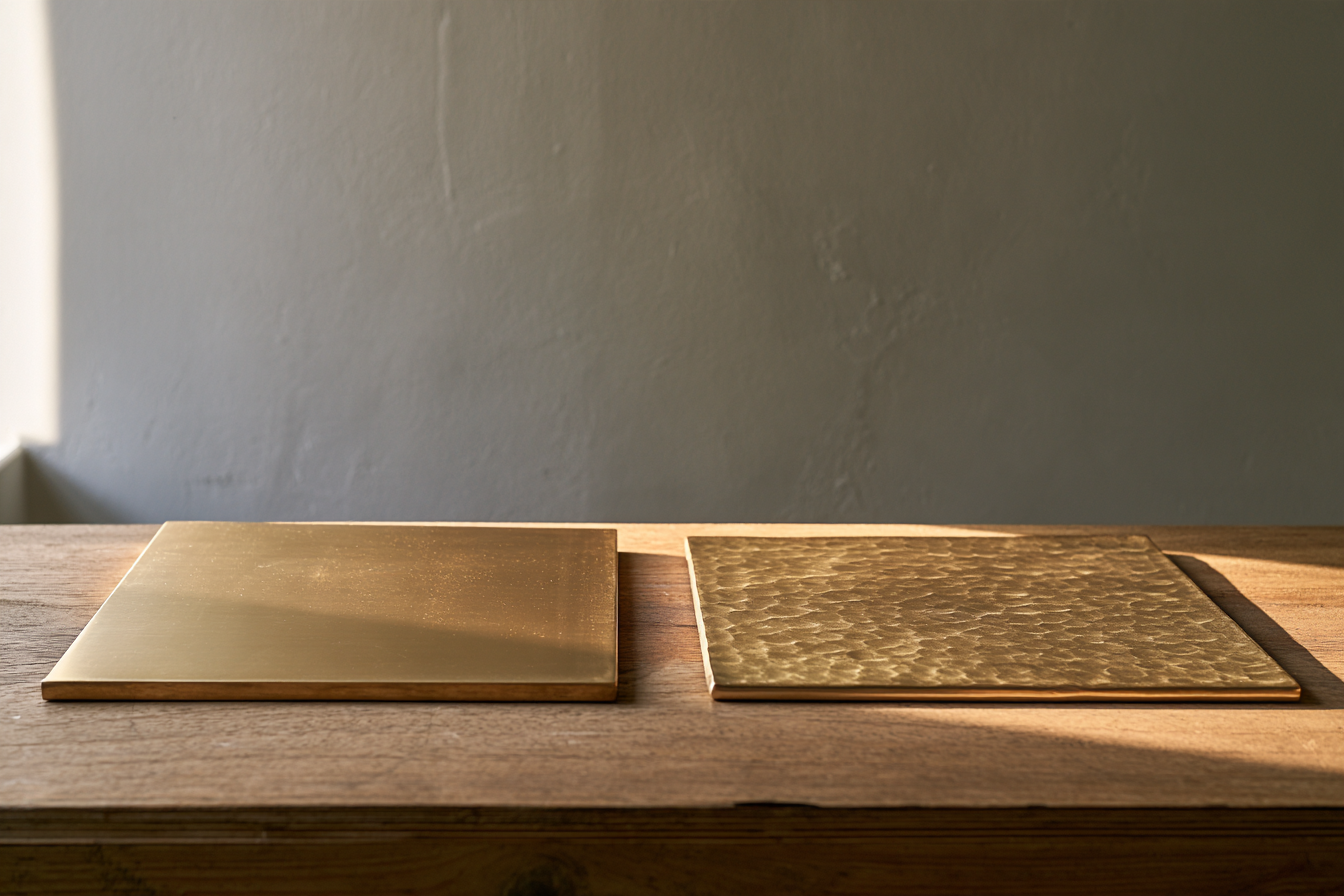
AI-generated image. Editorial illustration of two contrasting surfaces; not a photograph of fabricated metal objects.
Consider the generated image shown here. Two brass-coloured rectangles lie side by side on a wooden table. The left surface is relatively smooth; the right carries a field of shallow depressions. Light makes their differences visible. Those observations give us a starting point, but they do not establish a history of manufacture.
If I describe the pair as a contrast between industrial uniformity and handmade variation, I have proposed an interpretation. I have not identified how two actual objects were made. In this generated scene, the apparent tool marks are depicted marks. They are available for a reading about labour, but they do not document someone hammering metal. Knowing that the scene was generated changes the kind of claim the image can support without deciding every meaning it can have.
The proposed contrast also leaves something out. Light creates variation across the smoother plate, while the depressions on the other surface form a repeated pattern. The picture can therefore complicate a neat division between sameness and difference. I would want an accompanying sentence to leave room for those relations. Calling one side uniform and the other irregular too quickly would make the image easier to explain and less interesting to inspect.
That is a modest test of the theory’s usefulness. After reading the sentence, can I identify more precisely what the image does? Can I also name a detail that the sentence fails to explain? The second question does not require an image to defeat a theory. It checks whether I have mistaken one useful description for an exhaustive account.
From a subject to a decision
The problem becomes practical when making a series. Imagine a proposed book about memory containing generated rooms. An artist’s statement says that memory is incomplete. Every picture includes an empty place where an object might be expected, a dark corner or an interrupted view. The pictures fit the statement, but their agreement alone gives the editor little help in choosing among them. This is an imagined editing problem, not a report of a book or audience study.
One way forward is to make the claim more specific. Perhaps one image withholds the far end of a room, while the next reveals it and makes the earlier space seem smaller. In that sequence, incompleteness has consequences for how a distance is judged and later reconsidered. The two images give the reader something to compare. The general theme has become a relation between particular pages.
Another book might need no such revelation. It could sustain an incomplete view throughout. Its decisions would then concern how each return changes the experience of that limit: what remains visible, how long an interval lasts, where one image differs from the last. Repetition would have to be considered in the sequence itself. The word memory cannot settle those decisions on the editor’s behalf.
I would keep the statement beside the sequence while editing and ask what each asks of the other. A sentence may identify the question that brought the work into being. A particular image may then require the sentence to become narrower, more exact or less confident. Sometimes the image should change; sometimes the writing should. There is no reason to assume the theory always gets the final revision.
This leaves theory with substantial work to do. It can establish distinctions, reveal an assumption or help formulate a question that the images alone would not have prompted. I would trust it most when it makes a decision more accountable: why this surface, this distance, this image at this point in the book? If those choices remain interchangeable after the explanation, I still have work to do.
Related reading
What Explanation Does considers how words guide attention and what a caption asks a visible detail to support. This essay extends that concern to the ideas used to make and select a work.
References
LeWitt, Sol. 1967. “Paragraphs on Conceptual Art.” Artforum 5 (10): 79–83. Summer. Text reproduced by Fundación Proa. Reprint scan hosted by CUNY Academic Commons. The scan identifies the original publication and pagination; its anthology page numbers differ from the original.
The Museum of Modern Art. n.d. “Joseph Kosuth. One and Three Chairs. 1965.” Collection record, object no. 393.1970.a–c. Collection page. Accessed Nov. 19, 2026.