An image can sustain a reading its maker did not plan. What makes that reading persuasive?
White strips lie across the grey paving of a square. Some form corners or short crosses; one near the foreground lifts away from the ground. The paving joints lead towards buildings at the far side. Small figures remain near the edges, while the broad centre is unoccupied. There is room to imagine an event that has ended, or one that has not yet begun.
The image is AI-generated. Its embedded description asks for a square on the morning after an outdoor event, with tape remaining where stalls stood. That gives us a documented production instruction. It does not establish an event in the world, and it does not require the viewer to experience the result as an aftermath.
Suppose someone reads the marks as preparations for a gathering. Would that person have misunderstood the image, or noticed a possibility the instruction left open?
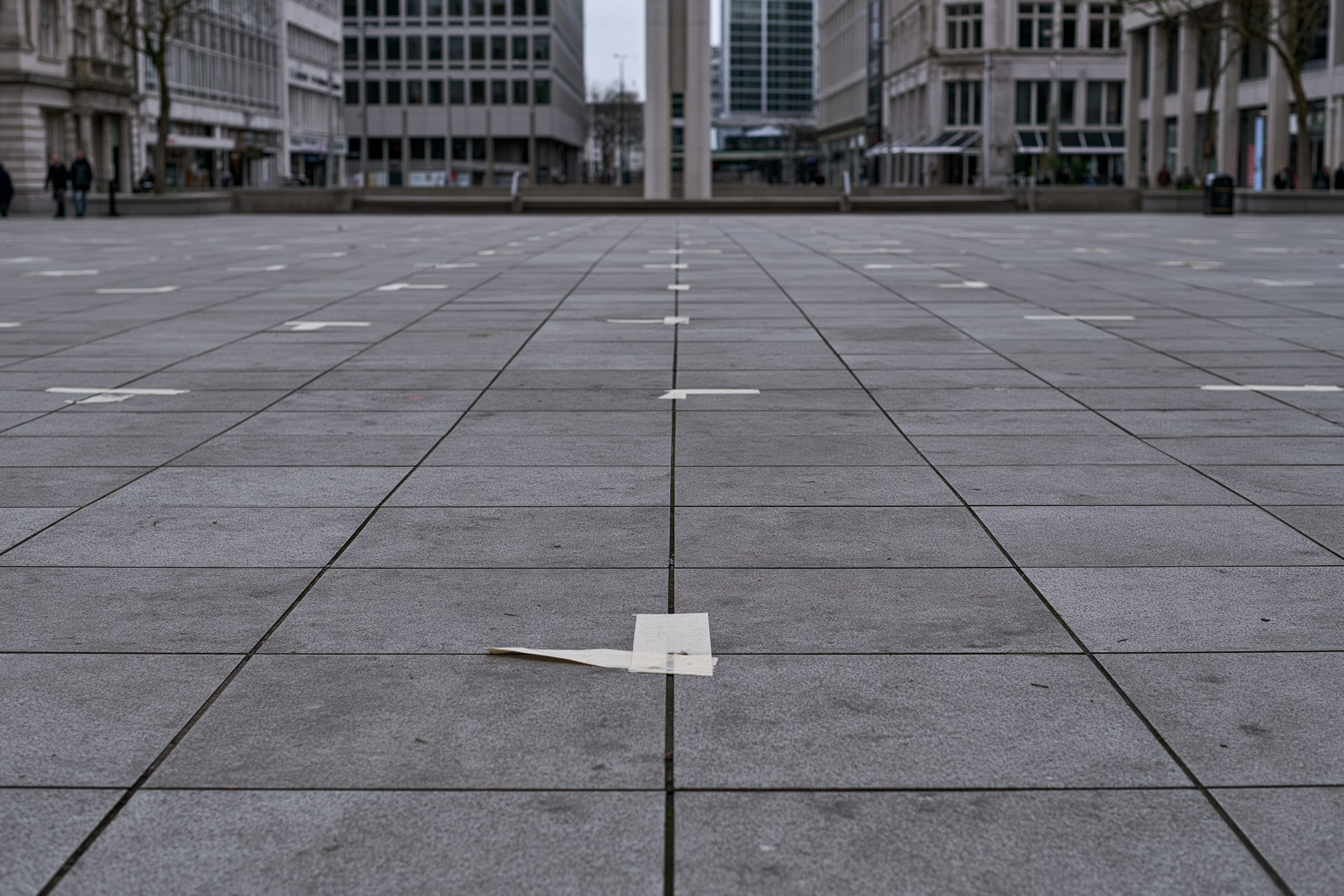
Young Chai · AI-generated editorial illustration. The image is used here to compare possible readings; it does not document an actual event. “Aftermath” and “preparation” are interpretive proposals, not artwork titles.
A request is not the finished image
The file’s description also asks for an empty square. The result contains people. Their small scale and peripheral positions leave the centre feeling vacant, but a claim that no one is visible would be inaccurate.
This modest discrepancy is useful. It separates what was requested from what can be inspected. A viewer who points out the figures has corrected a description; a viewer who finds the square lonely has offered a reading. The second need not be cancelled by the first. A space with people at its edges can still feel lonely. Yet the reading must now accommodate those people, rather than make them disappear.
Nor is a generation instruction the whole of artistic intention. It records a request made at one stage. Selection, cropping, sequencing and presentation can give a result a purpose that the request did not anticipate. I would therefore hesitate to use the prompt as an answer key. It can explain something about the making without settling what the finished image makes available.
What can constrain a reading?
In his Tanner Lectures, Umberto Eco distinguishes the author’s intention, the interpreter’s intention and the intentio operis, or intention of the work. His argument allows multiple readings while asking whether a proposed interpretation remains consistent with the text as a whole. An isolated detail cannot simply be detached from everything that might qualify it (Eco, 1990).
I take this as a useful challenge, rather than a ready-made rule for pictures. Eco’s discussion concerns textual interpretation. A single image does not organise its relations in the same way as a sentence or novel, and its boundaries may extend into a sequence, a caption or an installation. Applying his distinction here is my proposal.
For this square, the aftermath reading draws support from the partly lifted strip. Something appears to have begun coming apart. The regular spacing of the other marks can suggest a temporary arrangement whose objects have been removed. The unoccupied centre gives that imagined removal considerable visual space.
The preparation reading has grounds too. The same marks can designate positions still to be occupied. Repetition across the paving makes them look organised rather than randomly discarded. The few figures beyond the marked area need not be survivors of a vanished event; they could be ordinary passers-by beside an unfinished arrangement.
Neither reading can recover a real chronology from a generated scene. More importantly for interpretation, each meets resistance. Preparation must explain the lifted strip. Aftermath must explain why the remaining arrangement still looks so orderly. Those details do not decide the matter, but they keep either account from becoming effortless.
The danger of deciding too soon
There is an objection to this way of testing a reading: it could reward whatever already seems familiar. If I decide in advance that the image is about an event, I may allow only interpretations that rearrange the same story. Both aftermath and preparation would then obey a boundary I had quietly imposed.
Jonathan Culler’s contribution to Interpretation and Overinterpretation supplies a useful complication. In its opening, he defends overinterpretation and insists that a text can challenge the conceptual framework brought to it, rather than merely serve the reader’s purposes (Culler, 1992). The issue is not only whether a reading fits, but whether the encounter might change the questions being asked.
In this image, another viewer might attend to the agreement between two grids: the permanent paving and the temporary white marks. From that relation, the square could become a way of thinking about how public space is divided into usable positions. That reading moves beyond the before-or-after story. Its interest would depend on explaining the particular relation between the grids, not simply attaching a general statement about power to an urban scene.
It would also have limits. Nothing here establishes who placed the marks, what authority they held, or whether anyone was excluded. Those would be claims requiring other evidence. A political interpretation can be worth pursuing without pretending that this image documents a particular political act.
Disagreement need not become a contest
The maker may know circumstances that the viewer cannot see. A factual account of production, a verified location in a photograph, or the declared fictional status of a work can change what is reasonable to claim. Interpretation does not make those distinctions dispensable. Conversely, production knowledge does not give the maker exclusive access to every relationship in the result.
For a working discussion, I would begin with the image alone and introduce its production description later. The order matters: it gives us a chance to notice which claims come from looking and which arrive with an account of how the image was made.
Try this with the square above, or with an image from your own work:
Write one sentence describing only what you can point to. Here, “small figures stand near the edges” is more precise than “the square is deserted.”
Propose two different readings. For each, name one visible detail that supports it and one that makes it harder to sustain. The lifted strip, for instance, does not sit equally comfortably with every account of preparation.
Read the production description or caption. Mark which claims it establishes about the making and which merely suggest a story about the scene. For a generated image, an instruction to show an aftermath is not evidence that an event occurred.
Revise a sentence, or keep it and explain why. Then ask whether both readings have overlooked another relation, such as the two grids.
This is a proposed exercise, not a report of a reader study or a method for scoring interpretations. Its useful result would be a more precise account of where a reading comes from, and where another reader might reasonably resist it.
There should also be room for a response that does not seek an argument. Someone may enjoy the subdued colour, recognise a familiar kind of square, or feel nothing in particular. The responsibility to offer reasons grows when we ask others to accept a claim about the work; it need not govern every private response to an image.
Here, I would leave the before and after unresolved. The lifted strip makes aftermath plausible; the repeated positions keep preparation available. The small figures prevent an absolute account of emptiness. A reading that can live with these details offers more than one that removes them to preserve its certainty.
The reader’s disagreement can then become useful to the maker. It shows where the image has taken a different direction from the instruction, and where the work still has something to ask of both of us.
References
Eco, U. (1990). Interpretation and overinterpretation: World, history, texts. Tanner Lectures delivered at Clare Hall, Cambridge University, March 7–8, 1990. Lecture text, Tanner Lectures archive. The year here identifies the lectures, not the later Cambridge book.
Culler, J. (1992). In defence of overinterpretation. In S. Collini (Ed.), Interpretation and overinterpretation (pp. 109–124). Cambridge University Press. https://doi.org/10.1017/CBO9780511627408.006.
Related reading
What Explanation Does considers how captions guide attention and what they ask an image to establish. This essay takes the next question: what happens when a reader does not accept that guidance?