When I worked directly at the microscope, looking began before I put my eye to it. I had to decide what I wanted to examine, choose dyes or antibodies, and prepare the specimen accordingly. Sometimes I used several fluorescent labels to distinguish different features within the same cell. I wrote down what I intended to look for before the experiment. I described this practice in an earlier Korean essay, “보는 일과 보인 것” (Chai, 2026).
That preparation made observation possible, but it did not make every conclusion reliable. I also recalled confusing similar-looking features in stained specimens. An image could be clear enough to see and still be misidentified.
This leaves a question that matters in my work with photography and AI-generated images: how can preparation sharpen observation without allowing the anticipated result to become the standard by which everything is judged?
Three kinds of preparation
In the laboratory, preparing the specimen changed what could become visible. Choosing a stain was a material intervention, not simply a different interpretation of an unchanged image. Directing attention was another operation: among the features available to inspection, I concentrated on those relevant to the question. Deciding what the observation supported required a further judgement.
These operations belong together, but separating them helps prevent an easy mistake. The fact that I chose what to investigate does not mean that I could choose which answer the specimen would provide. Nor does a feature’s visibility establish that I have identified it correctly.
Scientific seeing also has a history of instruction. Daston and Galison’s Objectivity examines scientific atlases and the different ideals embodied in their images, including the role of trained judgement. An atlas teaches practitioners which features merit attention and how to recognise them (Daston and Galison, 2007). Such training can make distinctions accessible that an inexperienced observer would miss. It can also make a familiar distinction feel like the only one available.
For an artist, preparation might mean knowing a medium’s history, recognising a compositional convention, or carrying a question from one work to another. These resources deserve to be used. The difficulty begins when they stop being resources and become requirements that every new image must satisfy.
Looking at the staircase
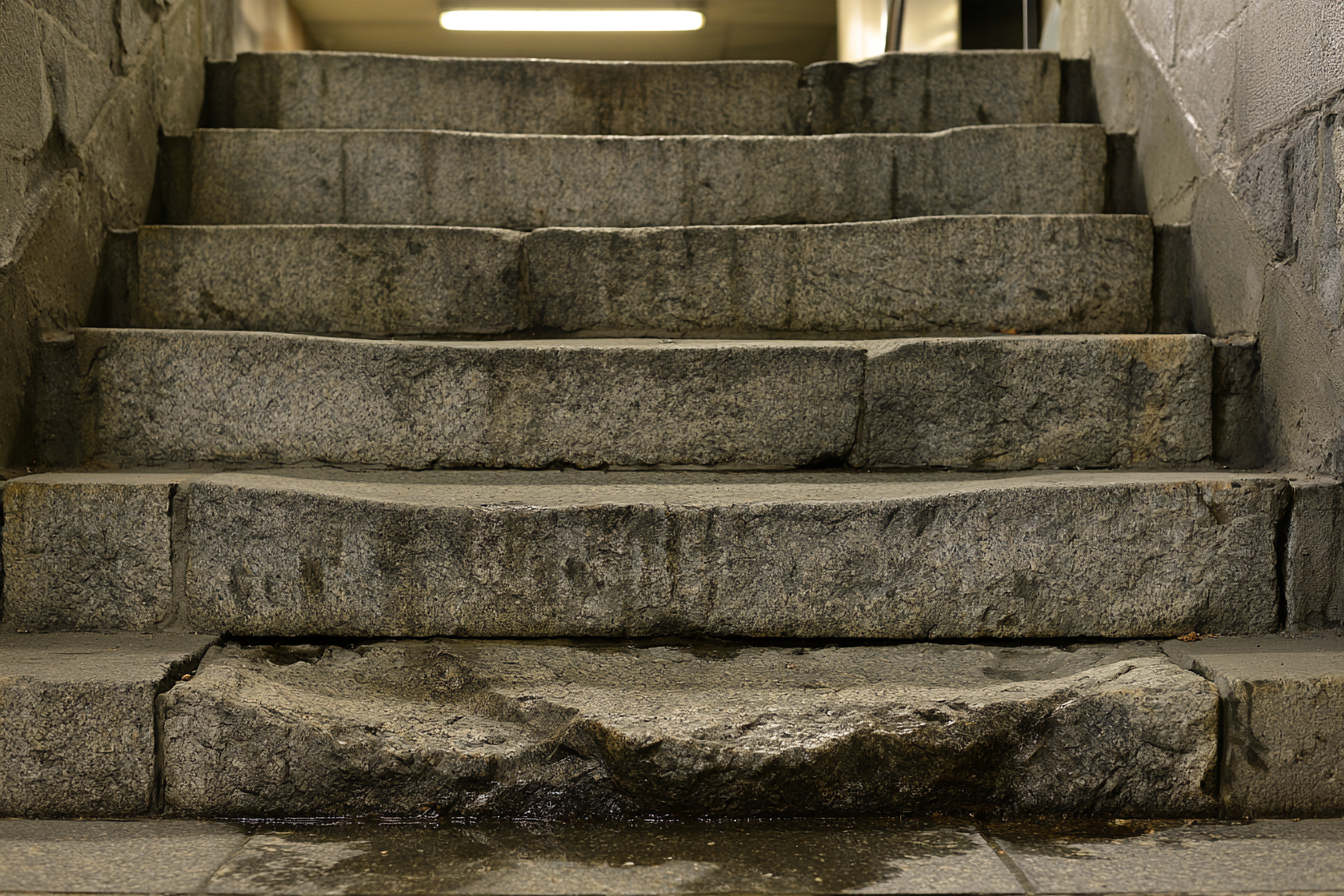
The lowest central tread in this generated image has a conspicuous hollow. Its edge is uneven, and dark reflective patches lie along its base and across the floor. Higher up, the broad horizontal bands of the staircase repeat towards a light near the top of the frame.
If I arrive with a question about repetition and difference, the damaged-looking lower tread offers an immediate answer. It interrupts an apparent sequence of regular steps. I could describe the composition as a single exception held against an orderly background.
Looking more closely makes that account less satisfactory. The steps above are not entirely regular. Their edges dip and rise; joins, cracks and variations in the stone interrupt the horizontal bands. The lower tread differs in degree and shape, but irregularity is distributed through the image. My first description made the contrast cleaner than the visible structure warrants.
A question about human use would direct me elsewhere. The hollow and the reflective floor might suggest repeated passage, exposure or maintenance. Those possibilities are associations, however, not established events. This is an AI-generated image. There is no photographed staircase here whose history I can reconstruct from the depicted marks.
The image remains available to interpretation. Its repetitions and interruptions can be discussed closely. What it cannot provide is documentary support for the history that its surfaces invite me to imagine. Preparation helps only if it includes knowing which kind of claim I am making.
Expertise changes with the task
A small study by Vogt and Magnussen compared nine artists with nine artistically untrained viewers across sixteen pictures. Artists devoted more scanning time to structural or abstract features, while the other group favoured recognisable objects and human features. Yet the artists’ viewing strategy changed when they were asked to remember the pictures: they then looked more at objects and human features (Vogt and Magnussen, 2007).
The useful point is the interaction between experience and purpose. The study does not establish that one group discovered the correct meanings of the pictures, or that training alone caused all the differences. It does suggest that an experienced viewer’s attention is responsive to the task.
This matters when I inspect the staircase. Looking for compositional order and looking for evidence of use are different tasks. Each can reveal something worth describing. Neither earns priority simply because I brought it to the image first.
Expecting a surprise is not enough
The instruction to remain open-minded sounds helpful, but it leaves the practical problem unresolved. A revealing study by Daniel Simons used a video in which participants counted basketball passes. Alongside a person in a gorilla suit, it included two other changes: a curtain changed colour and a player left the scene. Participants familiar with the earlier gorilla demonstration reliably noticed the gorilla, but they were no more likely to notice the other changes (Simons, 2010).
This was a constrained attention task, not an experiment in interpreting art. It nevertheless gives me a reason to be cautious about the confidence that comes from knowing a familiar warning. Recognising the kind of surprise I have been taught to expect does not establish that I have noticed everything else.
In image-making, even a search for ambiguity can become selective. If I prize the detail that disrupts a pattern, I may give every irregularity significance. The staircase’s conspicuous hollow could then become exactly the surprise I was waiting for.
Letting the question change
There is a reasonable objection here: without a particular interest, looking can become an aimless inventory. An artist cannot attend equally to every mark, and a coherent body of work requires choices. Preparation should not be treated as a fault simply because it excludes possibilities.
I would therefore keep the initial question and make its limits visible. For this staircase, I can first describe the contrast that drew my attention, then identify the details that complicate it. I can distinguish the depicted hollow from the history I associate with it. I can also ask whether another account explains more of the image with fewer unsupported assumptions.
The resulting reading need not be indecisive. I find the staircase more interesting as an uneven repetition than as one damaged step opposed to several perfect ones. The higher edges give that judgement a visible basis. A different reader can examine the same edges and disagree.
In the laboratory, an observation had to remain answerable to the specimen and the method. In an artwork, the relevant constraints differ: visible relations, medium, context and documented circumstances all matter. Carrying a question into either encounter is necessary work. The more demanding work begins when something available to inspection makes that question inadequate.
References
Chai, Y. (2026, October 20). 보는 일과 보인 것. Brunch Story.
The laboratory recollections in this essay originate in this Korean text. The discussion developed here is a new English essay.
Daston, L., and Galison, P. (2007). Objectivity. Zone Books.
Simons, D. J. (2010). Monkeying around with the gorillas in our midst: Familiarity with an inattentional-blindness task does not improve the detection of unexpected events. i-Perception, 1(1), 3–6. DOI · Open text
Vogt, S., and Magnussen, S. (2007). Expertise in pictorial perception: Eye-movement patterns and visual memory in artists and laymen. Perception, 36(1), 91–100. DOI · Publisher record and abstract