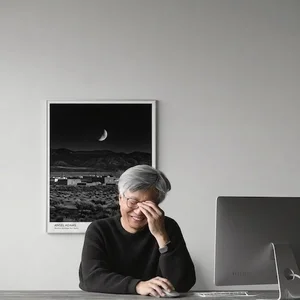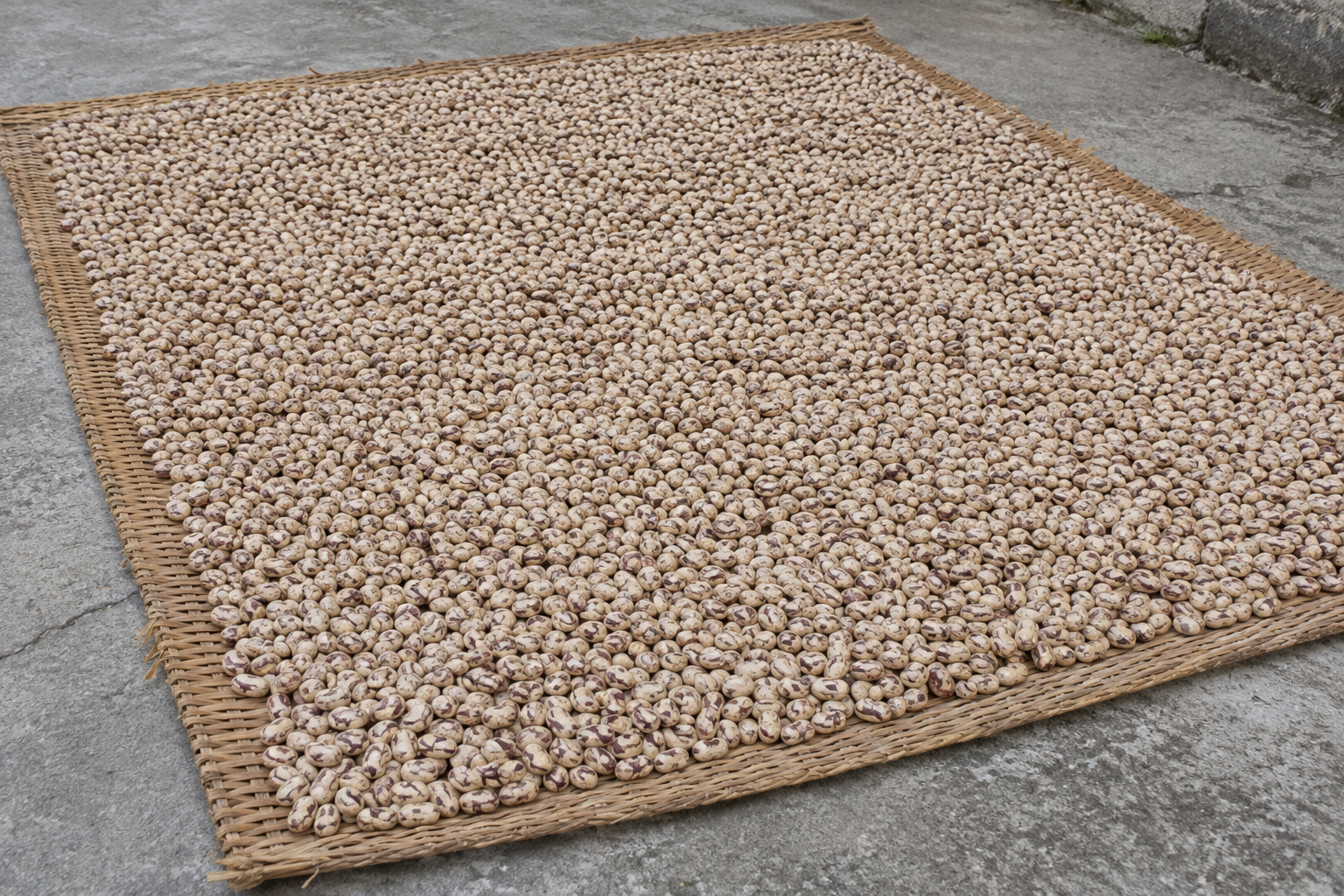
Young Chai. Editorial illustration from the Korean essay: individual beans gather into a patterned surface. This is not an installation view of the exhibition discussed below.
At a Martin Parr retrospective, some photographs near the entrance were larger than a person. Elsewhere, the Common Sense section crowded 270 photographs onto a wall. I moved closer, then stepped back. Close up, I could read individual pictures: food, hands, clothing patterns, skin. From farther away, those particulars receded into a field of colour. In my Korean account, I described this as two exhibitions separated by a few steps (Chai, 2026).
What changed was the unit I was looking at. A photograph could become one element in a larger composition, and that composition could break apart again into photographs. This makes the choice between one large print and many small ones more complicated than choosing between impact and intimacy. Scale helps determine what can be read together, what can be inspected separately, and how a viewer moves between those possibilities.
Physical dimensions alone do not settle the question. Viewed straight on from a position opposite its centre, a print twice as wide, seen from twice as far away, has the same angular width: it occupies the same horizontal angle in the viewer’s field of vision. Yet the encounters need not be equivalent. The larger object has a different relationship to the room and the body. Moving towards it may reveal details unavailable in the smaller print. Moving back may become necessary to gather its parts together. The room must permit those movements.
There is empirical reason to take this adjustment seriously. Claus-Christian Carbon observed 225 visitors looking at six Gerhard Richter paintings in a museum. Larger paintings were associated with greater self-chosen viewing distances (Carbon, 2017). The study concerns particular paintings and an exhibition setting; it does not establish an ideal distance for photographs. Nor did it enlarge the same picture under controlled conditions, so it cannot isolate size as the cause. Its useful reminder is more modest: viewers participate in establishing the conditions under which they see.
At Parr’s wall, stepping back changed the relationship between the photographs as well as their apparent size. The close views that seemed excessive individually could become an accumulated texture. My attention shifted from the particular object to the recurrence of bright surfaces and crowded fragments. This is my reading of that encounter, rather than evidence that every visitor experienced the wall in the same way. Another person might remain with individual images or find the accumulation exhausting.
The comparison with a book also needs care. Common Sense was published in 1999, and the publisher lists 158 colour photographs in that first edition (Parr, 1999). The book and the 270-picture installation I recorded were therefore already different selections. They cannot be treated as an experiment in which only the display format changed. Turning pages and scanning a wall offer different routes through the work, but the photographs selected for each route matter too.
In the earlier essay, I said that the book could not do what the wall did. I would now qualify that claim. A book can offer an overview, a montage, or a fold-out. It can also make two images confront one another with a precision that a busy wall might dissipate. What it cannot reproduce unchanged is my movement through that particular room, between the wall as a field and the photographs as separate objects. Its alternatives deserve to be judged as choices, rather than failures to imitate an exhibition.
There is a further objection to the title of this essay: exhibitions need not choose one scale. MoMA describes Wolfgang Tillmans’s installations as arrangements made for particular exhibition spaces, bringing together photographs printed at different scales whose images can also function individually (Museum of Modern Art, n.d.). This practice offers another possibility. A large photograph and a smaller neighbour can establish an unequal relationship without making either redundant. Whether that inequality is productive has to be shown in the particular arrangement; size alone does not explain it.
Abundance can certainly conceal weak decisions. A dense wall may turn distinct subjects into an attractive surface, making differences harder to examine. A large isolated print can confer apparent importance on an image that offers little beyond its initial effect. Neither criticism is answered by saying that the artist intended the presentation. The relevant question is what becomes available to a viewer because of that choice, and what becomes difficult or impossible to see.
This matters equally when an image begins in a generative model. The file does not supply its own exhibition dimensions. Enlarging it can change the relation of details to the whole; surrounding it with other images can change which features seem significant. Those consequences need to be examined in the eventual presentation. The novelty of the production method is not a reason to assume that a larger print, or a larger quantity of prints, will make a stronger work.
For my own work, I would begin with a question about the intended encounter. Does the image need to be grasped whole before its details become important? Does a group need to be seen together before its differences emerge? A small layout can help me plan those relations, but I would still need to check them at the proposed scale and viewing distance. At Parr’s wall, the ability to move between individual pictures and the larger field was what stayed with me. I would want my own decisions about size to offer a comparably specific reason for the viewer to move.
References
Carbon, C.-C. (2017). Art perception in the museum: How we spend time and space in art exhibitions. i-Perception, 8(1). DOI
Chai, Y. (2026, 15 October). 한 장을 크게, 이백칠십 장을 빼곡히 [One image large, 270 densely arranged]. Brunch Story. Original Korean essay. This English essay develops the Korean account with research on viewing distance and a discussion of alternative display choices.
Museum of Modern Art. (n.d.). Wolfgang Tillmans. 303 in grass. 1993. Collection entry, including commentary on Tillmans’s installations. Collection entry
Parr, M. (1999). Common Sense. Dewi Lewis Publishing. Publisher’s first-edition record