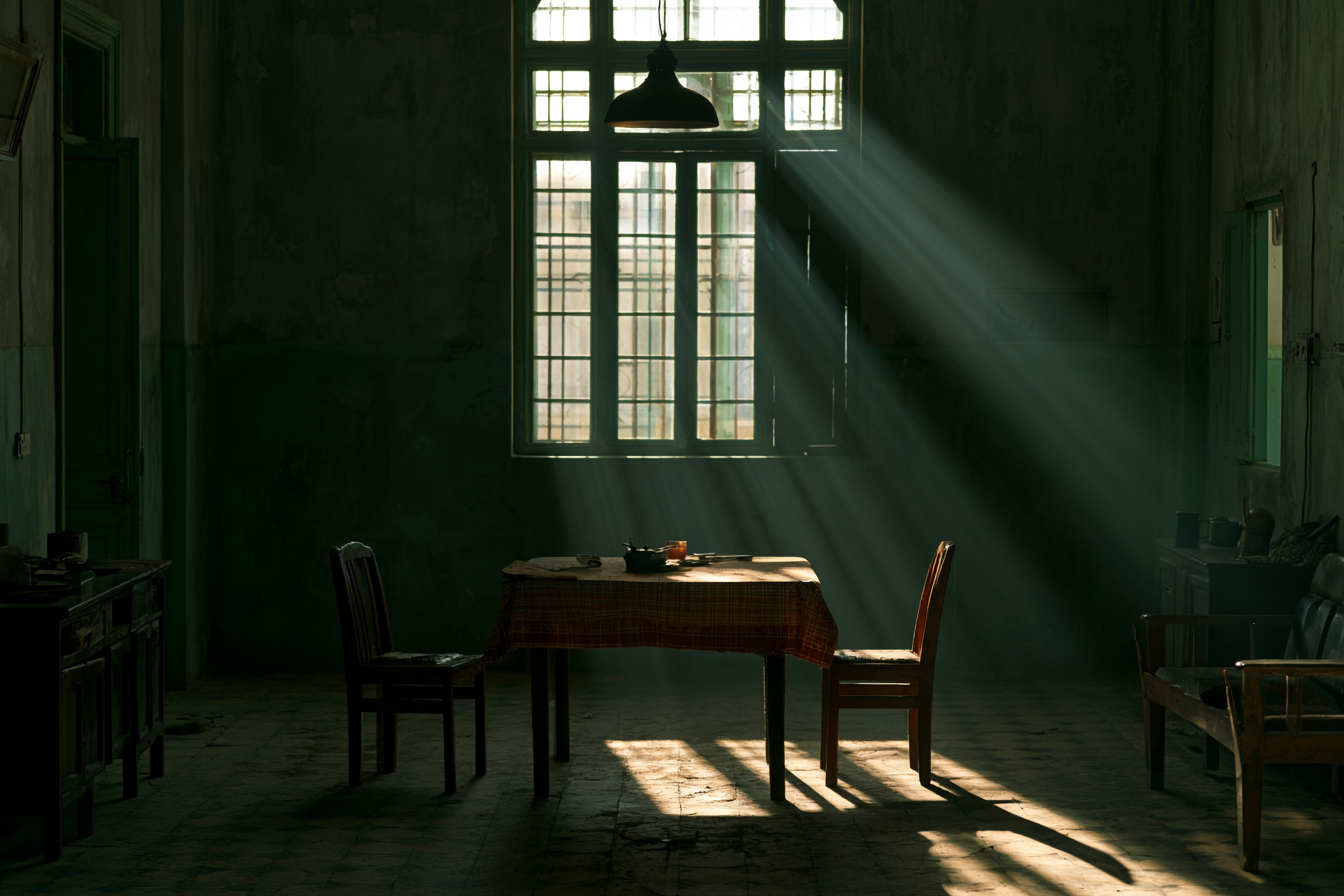
Young Chai. AI-generated editorial image. An imagined interior; not a record of an actual room.
The window is the brightest large area in this image. Below it, two chairs face one another across a table. The chair on the right catches light; the other remains much darker. A strip of the tablecloth and patches of floor are illuminated. The hanging lamp, although placed in front of the window, is a dark shape.
It is tempting to say that the light tells us where to look. That leaves a more difficult question unanswered: does it also tell us what matters? The window establishes a strong visual centre. Yet the relation between the chairs may become more important if I begin to read the room as a place where people might meet. The brightest area and the organising question of that reading are not identical.
I want to distinguish three things: the distribution of light and dark in an image, the distribution of a viewer’s attention, and the importance that particular details acquire in an interpretation. They can support one another. They should not be treated as interchangeable measurements.
Brightness needs a surrounding
A useful complication comes from visual-attention research. The influential model developed by Itti, Koch and Niebur combines contrasts in intensity, colour and orientation across spatial scales. Its saliency map represents conspicuous locations; it is not simply a search for the whitest pixels (Itti, Koch and Niebur, 1998). A dark feature can stand out because of its relationship to a light surround.
This helps me describe the room more carefully. The lamp interrupts the luminous window. The right-hand chair is legible partly through the contrast along its narrow back. Light does not merely place a spotlight on an already complete subject. It establishes edges and separations through which objects become available to inspection.
That is a description of the image, not a prediction that every reader will inspect its parts in the same order. I have not recorded anyone’s eye movements here. The composition offers several routes: window to table, chair to chair, or light on the floor towards the furniture. Even a convincing account of those routes would not establish what the room means.
What a map of meaning measures
Henderson and Hayes approached attention from another direction. They asked people to rate small scene patches for how informative or recognisable they were, then combined those ratings into meaning maps. In their study, these maps explained the distribution of recorded fixations better than the Graph-based Visual Saliency (GBVS) model used for comparison (Henderson and Hayes, 2017).
The result is relevant to an image-maker because it challenges an account of looking based only on elementary visual contrasts. But the word meaning requires care. The rated informativeness of a small patch is not the same thing as a reading of an artwork. Recognising a chair does not establish whether it signifies hospitality, loneliness or simply a place to sit.
The measurement itself has also been disputed. Pedziwiatr and colleagues found that changes in object–scene relationships affected viewers’ fixations in ways that their meaning maps and a deep saliency model did not capture (Pedziwiatr et al., 2021). Henderson and colleagues replied that the original maps were designed to represent local semantic information, not every contextual relationship (Henderson et al., 2021).
I do not need to settle that methodological dispute to take its distinction seriously. Naming what a model measures matters. Neither a map of contrast nor a map of local informativeness could, by itself, justify my interpretation of the two chairs. The empirical question of where viewers look and the critical question of what supports a reading need different kinds of evidence.
Two readings of the room
The furniture suggests human use, but the image does not tell me whether anyone has left or is expected to arrive. The chairs could support a reading of interrupted company. The household objects and worn surfaces could equally support an ordinary interior study, with light as its main interest. I should not turn an appealing suggestion into an event that the picture has documented.
This is especially clear because the image was generated. There was no photographed room whose occupants can be recovered from these objects. Its ability to suggest an encounter depends on the visible arrangement and on what a viewer brings to it. The uncertainty remains part of the reading.
Nor would darkening the window necessarily improve the image by making the chairs more prominent. The window gives the furniture a spatial and tonal setting. An adjustment intended to strengthen the apparent subject might weaken the relations that made it worth considering. The question is what the bright area contributes to the whole, including the quieter details around it.
When the shadow carries the question

Young Chai. AI-generated editorial image. The depicted shadows do not document people standing at an actual location.
In this second image, pale reflections break across wet ground, while two long dark forms run through the frame. Their rounded ends and proportions invite recognition as human shadows. The people themselves are outside the image. Brightness makes the surface visible; the dark forms introduce the possibility of a relation between two absent bodies.
I can read companionship into that relation, but the image gives no basis for naming the people or deciding what they feel. I could also attend to the bands of tone, the changing texture of the ground, and the irregular edges of the reflections. That reading would not be a failure to discover a hidden human story. It would give different visible relations priority.
The comparison does not show that darkness is inherently more meaningful than light. In both images, the readable dark forms depend on adjacent lighter areas. Their potential significance emerges through that relationship. A bright patch may be essential even when it is not the object around which my interpretation develops.
A decision for the image-maker
For editing, I find it useful to ask what would be lost if a conspicuous region were reduced. Would another detail become readable, or would the image lose the contrast that held its parts together? Conversely, if a subtle detail matters only after I explain it, I need to consider whether the image gives that detail enough support.
These are questions to test in particular images. They do not yield a rule that the subject must be brightest, or that a good image should delay its meaning in shadow. I would want the relation between light and subject to be specific enough that changing it changes the encounter. The room and the shadows offer different ways to examine that relation, while leaving room for a reader to give their details a different order of importance.
References
Henderson, J. M., and Hayes, T. R. (2017). Meaning-based guidance of attention in scenes as revealed by meaning maps. Nature Human Behaviour, 1, 743–747. DOI · Author manuscript
Henderson, J. M., Hayes, T. R., Peacock, C. E., and Rehrig, G. (2021). Meaning maps capture the density of local semantic features in scenes: A reply to Pedziwiatr, Kümmerer, Wallis, Bethge & Teufel (2021). Cognition, 214, 104742. DOI · Author copy
Itti, L., Koch, C., and Niebur, E. (1998). A model of saliency-based visual attention for rapid scene analysis. IEEE Transactions on Pattern Analysis and Machine Intelligence, 20(11), 1254–1259. DOI · Full text
Pedziwiatr, M. A., Kümmerer, M., Wallis, T. S. A., Bethge, M., and Teufel, C. (2021). Meaning maps and saliency models based on deep convolutional neural networks are insensitive to image meaning when predicting human fixations. Cognition, 206, 104465. DOI · Institutional repository