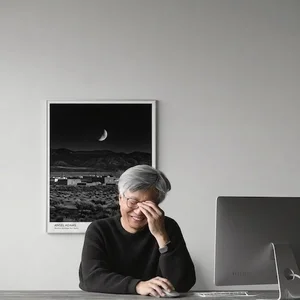
A bright cinema screen usually asks us to follow what appears on it. In Hiroshi Sugimoto’s Theaters, the screen gives us no scene to follow. His procedure was to keep the camera shutter open throughout a film. On his website, he recalls opening it when a screening began and closing it two hours later.[1] The resulting white screen makes the word duration difficult: a lengthy exposure has produced an image from which the film’s unfolding cannot be recovered.
When I ask whether a still image contains time, I need to be more precise. I may mean the interval involved in making it, the events it invites me to imagine, or the time I spend looking. These can work together. They can also pull apart.
The interval that makes the photograph
John Szarkowski challenged the idea of the photographic instant: “There is in fact no such thing as an instantaneous photograph.”[2] An exposure always occupies an interval, however brief. Calling a photograph a frozen moment makes that interval easy to overlook.
Yet increasing its length does not necessarily increase the number of events we can distinguish. A longer exposure can merge positions or remove the legibility of an action. The question becomes what kind of temporal difference survives the process. A photographed blur may disclose movement while withholding the sequence of positions through which it occurred.
Sugimoto makes this problem unusually clear. A film depends on one image succeeding another. Exposing a single frame across the screening changes that relation. The screen’s successive states contribute to the photograph, but they do not remain available as successive states. We cannot start at one corner of the white rectangle and read our way towards the film’s ending.
Registration and recognition
Sandra Plummer offers a productive way to approach this difficulty. In her discussion of Gary Schneider’s long-exposure portraits, she argues that still photography can convey duration through the movement accumulated during an exposure. Her account also distinguishes the time of recording from the time of presentation: a still photograph does not require us to undergo its making-time again.[3]
This allows more than one response to Sugimoto. We might understand the white screen as a concentration of duration. We might also attend to the temporal distinctions that have become inaccessible. Both readings acknowledge the exposure; they differ over what it makes available to a viewer.
In a 2025 interview with James Beacham, Sugimoto describes the apparent emptiness of the screen as the result of an abundance of information.[4] I take that as an account of the work’s conception, rather than a promise that the accumulated scenes remain recoverable. The photograph records an encounter with projected light. Recognising individual events is another matter. Its force lies partly in making these two achievements come apart.
The time an image invites
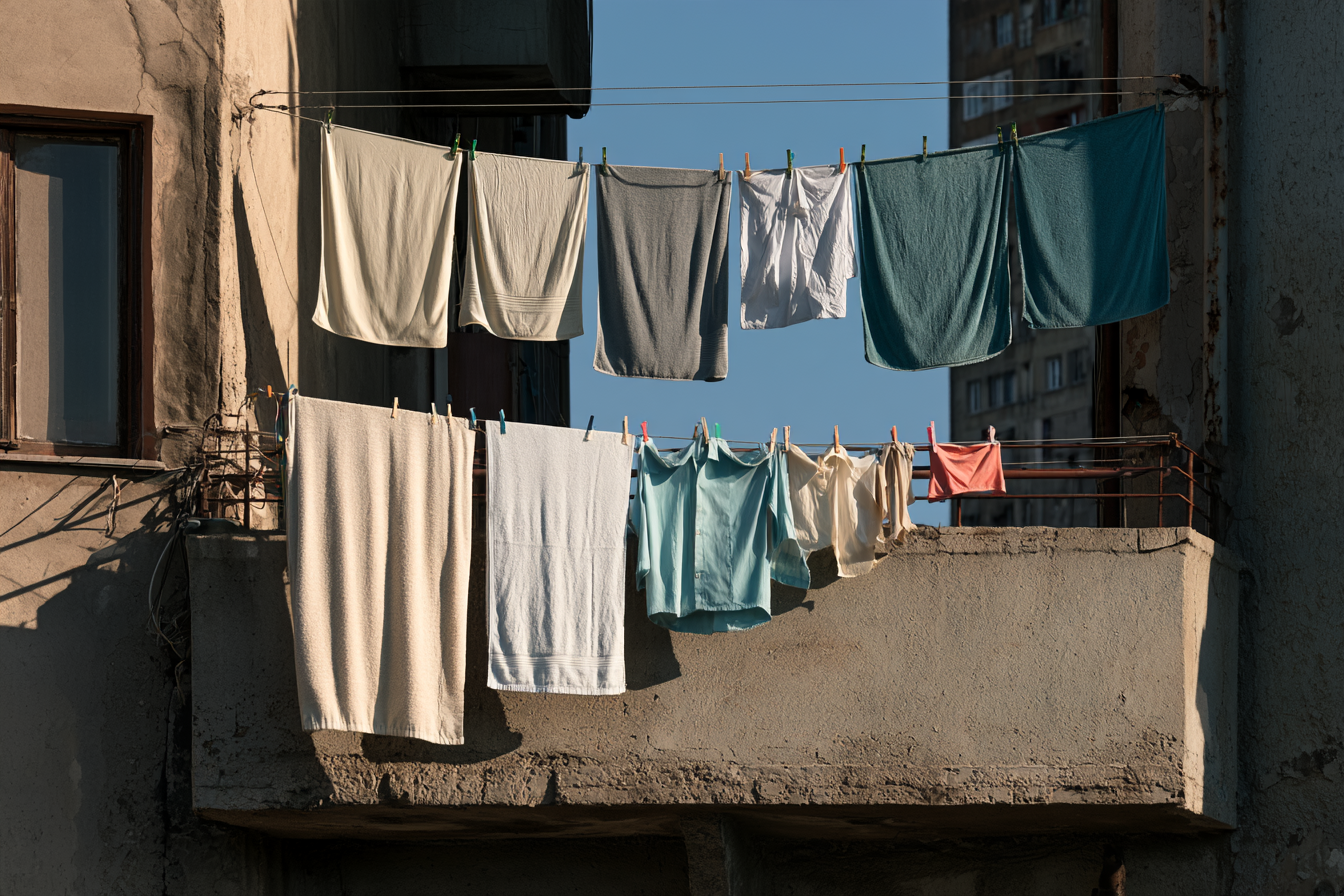
The generated illustration accompanying this essay offers a different case. Towels and shirts hang from lines across a concrete balcony. Their presence invites a small sequence: someone has washed them, put them outside, and will eventually bring them in. None of those actions is shown. Even whether the fabric is wet remains uncertain.
Nevertheless, these possibilities can structure the image. The suspended clothes can hold the interval between one domestic action and the next. A viewer may supply a morning’s work or the expectation of an afternoon return. Such a reading is a construction from the visible arrangement and familiar habits, not a verified history of this balcony.
An AI-generated image can support that construction without having recorded a period of drying. Its production took time, but the model’s processing time is not the elapsed time of the scene it depicts. The distinction gives me a more useful question than whether an image simply possesses or lacks duration: Which temporal relation does the work ask its viewer to imagine, and what in the image sustains it?
What knowing the method changes
There is a serious objection here. If a generated image could resemble a long-exposure photograph closely enough, might the same temporal experience arise from either one? A viewer might feel waiting, stillness or exhaustion without knowing how either image was made. If that happens, the production method cannot be the sole source of the experience.
I accept that objection. Aesthetic experience need not be an accurate diagnosis of a process. But resemblance does not settle every question we can ask of a work. Once a particular method becomes part of its claim, it matters whether that method occurred. Sugimoto’s procedure gives the white screen a relation to an actual screening. An imagined version could explore the appearance or idea of that relation; it would need its own account of what it is doing.
Knowing the method can therefore redirect attention without dictating a response. It can make an apparently empty area worth revisiting. It cannot compel a viewer to find that area moving, or excuse the work from the demands of its visible form.
Time given to looking
The third interval belongs to the viewer. I can return to a still image, compare its parts, leave it, and encounter it again. This time need not match either the exposure or the duration suggested by its subject. A brief exposure can prompt repeated looking; a prolonged exposure can be understood and dismissed quickly.
For a photobook, that distinction has practical consequences. A full-page image does not guarantee attention. Nor does a sparse spread automatically produce contemplation. The question is what a return allows the reader to notice: a relation missed on first looking, a detail altered by the next image, or an expectation the sequence quietly revises.
I would judge an image’s temporal work through those specific changes. Does it register a passage, suggest one, or give me a reason to reconsider what I have already seen? Sugimoto’s white screen makes the first two difficult to separate. The balcony’s hanging clothes make imagined passage possible without recording it. In each case, the time of my looking has to find its own relation to the image.
References
- Sugimoto, Hiroshi. “Theaters” / “劇場.” Artist’s statement and selected works, official website. Read the statement and view the works. The statement is in Japanese; the exposure procedure is also described in Fraenkel Gallery’s 2016 exhibition account.
- Szarkowski, John. The Photographer’s Eye. The Museum of Modern Art, 1966. The sentence quoted above is reproduced in MoMA’s contemporary press release, Dec. 5, 1966, p. 2.
- Plummer, Sandra. “Photography and Duration: Time Exposure and Time-Image.” Rhizomes, no. 23, 2012, especially paragraphs 13, 28–29 and 39. Read the article.
- Beacham, James. “Hiroshi Sugimoto by James Beacham.” BOMB, Jun. 16, 2025. Interview with Hiroshi Sugimoto. Read the interview.