An image can earn a place in the first selection before there is a sentence to explain it. Something holds: a distance, an interruption, a relation between shapes that would be difficult to specify in advance. The explanation arrives later, sometimes with surprising ease. By then, however, two questions have become entangled. What drew us to the image? And what would justify keeping it now?
Those questions need not have the same answer. A reason discovered later can improve a choice without describing its origin. Equally, an elegant explanation can protect a choice that deserves to be reconsidered. The important distinction is whether the explanation allows anything to count against it.
I would give an early preference room to develop. I would also resist calling that preference knowledge too quickly. “Keep this for now” leaves a different kind of space from “this is the right image”.
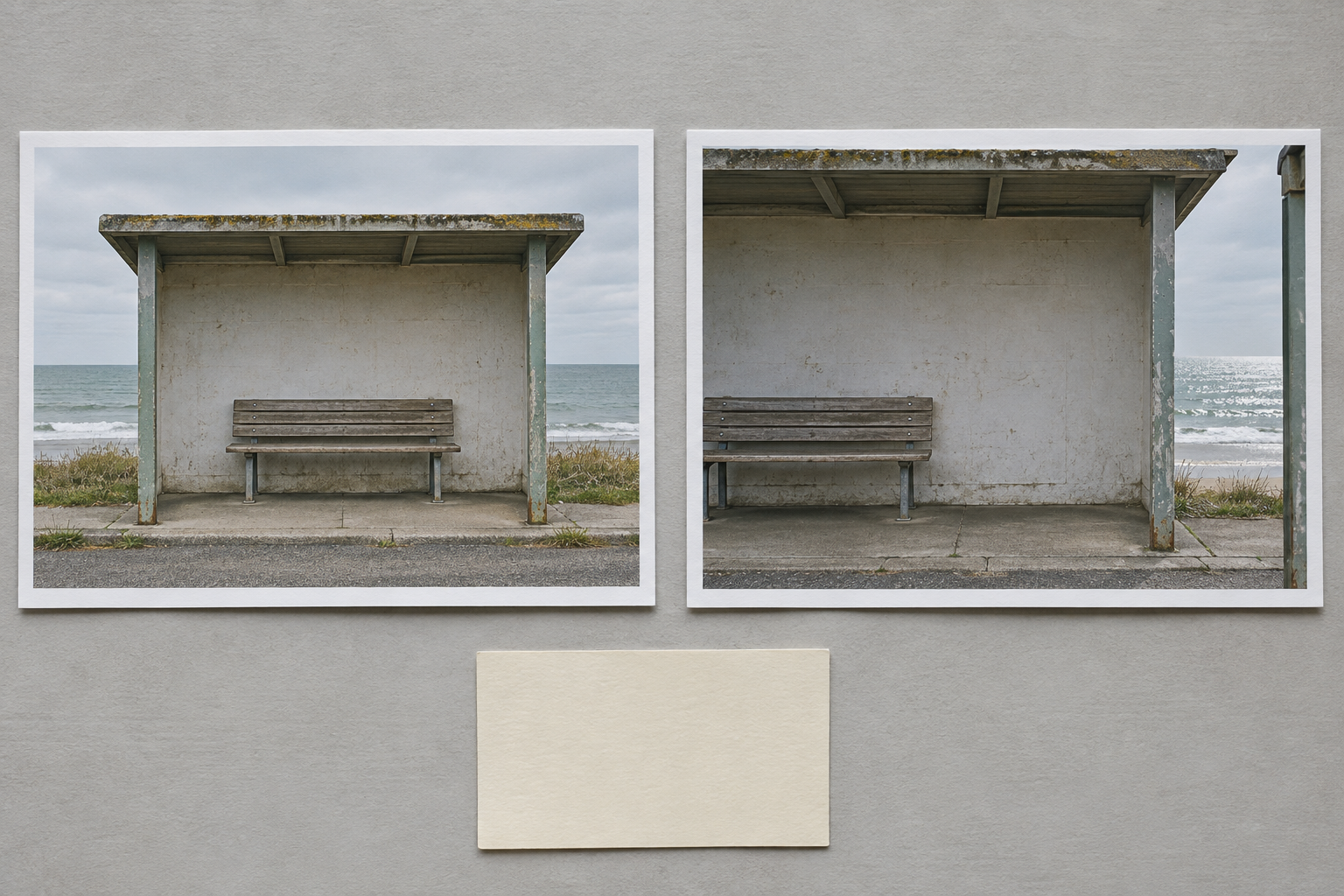
AI-generated editorial illustration made for this essay. The two shelter images are invented examples, not photographs of a documented place or records of the author’s selection process.
What a first choice leaves unexplained
Consider the two shelter images above. They were generated for this discussion; no reader experiment has been conducted with them. In the left-hand image, the bench occupies the centre beneath the roof. The upright supports frame the scene, and the sea remains visible on either side. The arrangement makes the shelter easy to recognise as a complete structure.
The right-hand image brings the shelter closer. The bench runs into the left edge. A broad area of wall occupies the middle, while the opening towards the sea lies on the right, beside a further cropped upright. There is less information about the whole structure and more pressure on the relation between the bench, the wall and that opening.
Suppose the second image attracts someone first. They might later describe it as more unsettled. That word is a possible interpretation, but it does little by itself. It becomes more useful when attached to something another person can inspect: the bench is cut off, the open view is displaced, and the empty wall separates them. A reader can follow this account and still prefer the first image.
There are credible reasons for that preference too. The frontal arrangement could make the empty seat more insistent. The balanced frame could suggest an ordinary public provision awaiting someone’s return. Symmetry does not establish complacency, any more than an awkward crop establishes depth. Both readings need the particulars of the image to remain in view.
The comparison also has a limit. These are invented pictures with differences in light, scale and surface, not a controlled test of centring alone. We cannot attribute a preference to one isolated feature. We can use the pair to examine the claims we make about our choices.
When explanation changes the object of attention
Timothy D. Wilson and Jonathan W. Schooler offer a caution about asking people to explain their preferences. In their 1991 study, students who analysed their reasons for liking strawberry jams agreed less with expert ratings than students who did not analyse those reasons. The researchers proposed that analysis could direct attention towards criteria that were less useful for the judgement being made (Wilson & Schooler, 1991).
That finding does not establish that thought damages art, or that expert consensus defines aesthetic value. Judging jam against an expert benchmark is a different task from making a book whose purposes may still be changing. Its relevance here is narrower: putting a preference into words can influence what receives attention. An explanation is not necessarily a transparent report of an untouched judgement.
Return to the shelter. Once the word “unsettled” has been written down, the cropped bench becomes easy to recruit as evidence. Other features may receive less attention. The larger blank wall might sustain a useful pause; it might simply occupy space without doing much. The initial word does not settle that difference.
A better account would make a claim we could revisit: “I prefer the second image because the distance between the cropped bench and the sea keeps my attention moving across the wall.” This still describes one person’s response. But it gives the next viewing a task. Does attention actually return to that interval? Does the wall remain active when the image is smaller? Or was the explanation more engaging than the image?
Here, words can help precisely because they expose a judgement to revision. The problem is not that a reason came late. It is that a late reason may be presented as if it had always governed the choice.
Experience gives intuition a history
The opposite response—trusting the first impression simply because it feels immediate—also needs examination. Daniel Kahneman and Gary Klein argued that assessing intuitive expertise requires attention to the environment’s regularities and the opportunity to learn them. The feeling of certainty is not a dependable measure of accuracy (Kahneman & Klein, 2009).
Their argument concerns conditions for skilled judgement; it does not supply a formula for artistic success. Still, it suggests a distinction worth carrying into image-making. Repeated experience of proofs can teach a maker how small tonal differences survive on a particular paper. Repeated experience of a familiar visual style may teach recognition of that style without settling whether it serves this new work. These are my applications of their distinction, not findings from a study of photobook editors.
Making many images provides many encounters with possible results. Learning from those encounters requires some way to notice what a choice does afterwards. An immediate preference, a successful print and an effective position in a sequence are different outcomes. Confidence in one should not silently stand in for evidence about another.
This matters for AI-generated images as well as photographs. A fluent description can be produced for either shelter. Asking an AI to defend the preferred image may yield useful observations, but the resulting fluency does not establish why the preference arose or whether the image belongs in the book. I would ask for a credible objection as well, then check both accounts against what is visible. That is a proposed use of the tool, not a report of a test performed here.
A reason that can change the selection
The strongest objection to this approach is that it might turn every choice into a small examination. Some images matter before their contribution becomes clear. Requiring an immediate defence could remove the unfamiliar picture and preserve the one that is easiest to explain. A book assembled only from readily stated reasons might lose the very uncertainty that made it worth making.
I would therefore separate permission to remain in consideration from a decision to publish. The first selection can include images whose reasons are unresolved. A later selection asks more of them, especially when they occupy space that another image could use.
For a modest working exercise, choose two candidates and record the initial preference in a few words before writing a defence. “The right one; I keep returning to the opening” is enough. Then place each candidate, in turn, between the same neighbouring images. Keep both short accounts: the first attraction and the reason for retaining or replacing it in that position. This is a suggested procedure, not a validated method for improving a book.
Imagine that the preceding page already contains a strongly centred architectural image. The balanced shelter might make a deliberate repetition; the closer shelter might disturb it. Neither consequence is inherently preferable. The decision depends on whether repetition or interruption contributes to the passage being made. A useful reason identifies that contribution and admits the possibility that the other candidate does it better.
Changing the explanation need not expose dishonesty. It may show that the question has changed. “This picture drew me back” describes an encounter. “This picture prevents the sequence from resolving too soon” proposes a function. The second claim should be tested in the sequence rather than borrowed as proof of the first.
What I would keep unresolved
There is value in retaining a small gap between a choice and its account. It allows the image to exceed the first description without making it immune to criticism. It also allows a maker to say something quite ordinary: I can see why I want to keep this, but I have not yet established where it belongs.
In the preceding essay, the relation between a wall and a page changed what a reader could inspect. Here the same responsibility turns towards the maker. Can the reason for a choice be inspected, and can it fail without being replaced immediately by a more convenient story?
I would keep the first attraction as part of the record. I would give greater weight to the image’s contribution after comparison. Sometimes the initial choice will survive; sometimes a quieter candidate will take its place. What matters is that the explanation remains answerable to the work while there is still time to change it.
References
Kahneman, D., & Klein, G. (2009). Conditions for intuitive expertise: A failure to disagree. American Psychologist, 64(6), 515–526. https://doi.org/10.1037/a0016755.
Wilson, T. D., & Schooler, J. W. (1991). Thinking too much: Introspection can reduce the quality of preferences and decisions. Journal of Personality and Social Psychology, 60(2), 181–192. https://doi.org/10.1037/0022-3514.60.2.181.
Related reading
The Distance Between the Wall and the Page — How placement changes what a reader can inspect and revisit.
The Reader’s Right to Disagree — How an interpretation can differ from the maker’s intention while remaining answerable to the image.